
As an Amazon Associate we earn from qualifying purchases.
The best reason to give someone an instant camera at Christmas is simple: they can photograph the people in the room, then hand them a real picture. Pikachu makes that idea especially appealing for a Pokémon fan. Film costs and small prints make it a less automatic choice than the bright yellow design suggests.
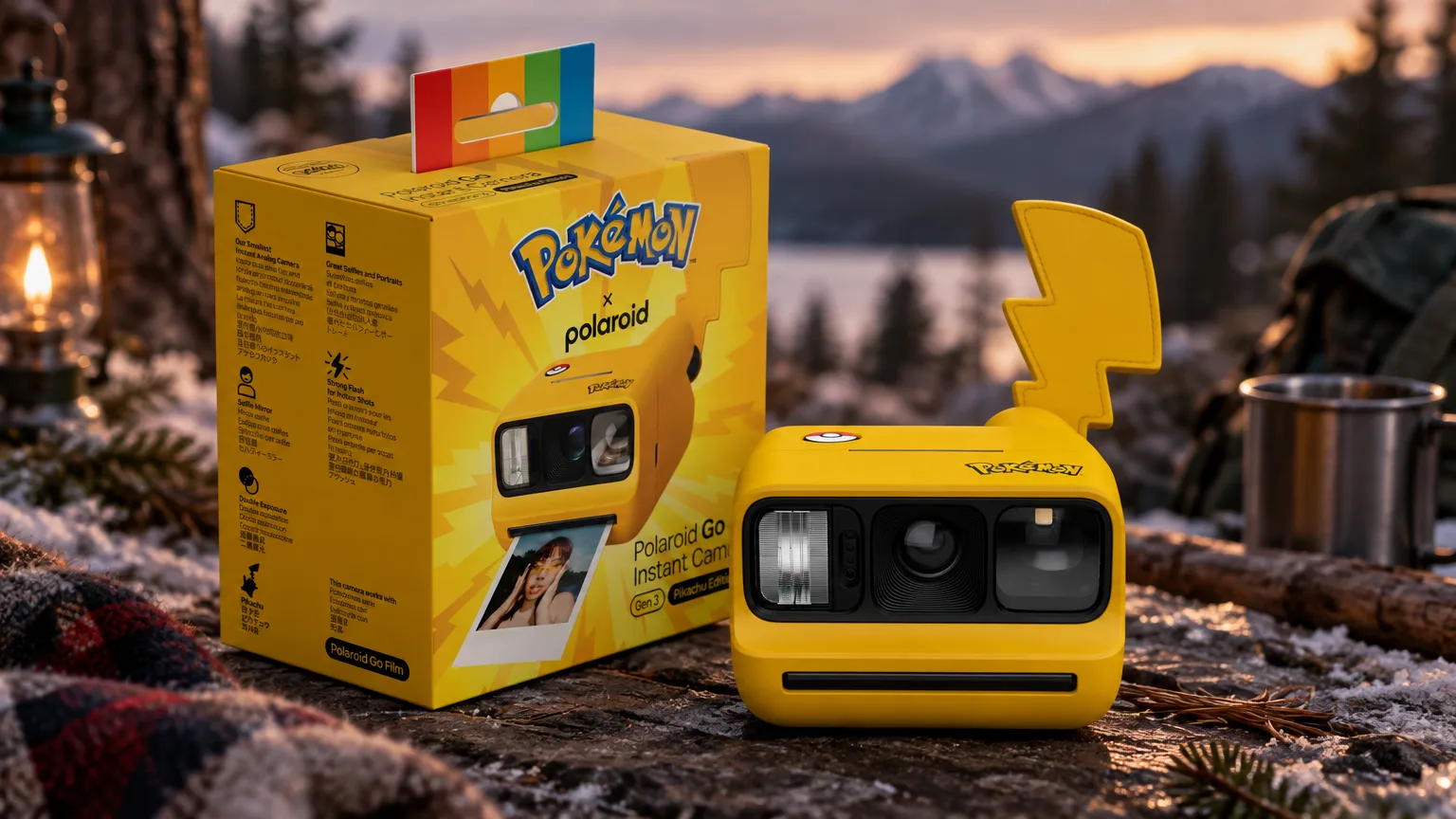
The Polaroid Go Gen3 Mini Instant Camera – Pokémon Pikachu Edition (9209) is a special-edition version of Polaroid’s small analog Go Gen 3. It pairs a Pikachu design and lightning-bolt lanyard charm with a selfie mirror, self-timer, double-exposure mode and rechargeable battery. It takes Polaroid Go film—not full-size Polaroid film—and its photos develop on the film rather than appearing on a screen.
It’s a strong Christmas gift for someone who likes both Pokémon and the act of making photos. It’s a weaker one for someone who mainly wants cheap prints, larger pictures or a camera that lets them review a shot before spending film on it.
The appeal is in using it, not just displaying it
Polaroid’s Pikachu edition includes a themed box and lightning-bolt lanyard charm. Those details give it the feel of a Pokémon collectible, but the Go is also small enough to bring to a party rather than leave on a shelf. Its mirror helps frame a selfie; the timer lets the photographer join a group shot; and double exposure puts two images onto one print.
That combination suits a fan who would enjoy photographing friends at a holiday gathering or making a little stack of keepsakes over winter break. Double exposure, in particular, offers something to try after the first few straightforward portraits. It’s also worth remembering that a special-edition camera doesn’t automatically produce Pokémon-themed photos. The character design is on the camera; themed borders require separate Pikachu Go film.
The Gen 3 hardware gives the gift more substance than a novelty shell. Polaroid describes a revised lens for sharper, tighter-framed selfies and a stronger flash. In a review of the standard Go Gen 3, Digital Camera World found its pictures sharper and more evenly exposed than those from earlier Go models in side-by-side shooting. That is evidence about the underlying camera, not a separate test of the Pikachu edition.
The small prints are part of the bargain
Polaroid Go film produces a print measuring 66.6 × 53.9 mm—about 2.6 × 2.1 inches—with a 47 × 46 mm image area. A standard 16-photo double pack takes about 10–15 minutes to develop. These are little photos for a wallet, album or phone case, not the large square pictures some people imagine when they hear “Polaroid.”
The camera uses a fixed-focus lens. Its appeal lies in framing a moment and accepting the result, not in adjusting focus or checking a preview. Polaroid lists a rechargeable lithium-ion battery, USB-C charging, and battery life of up to 15 film packs. Its listed box contents are the camera, lanyard charm, quick-start guide and safety leaflet; film isn’t on that list. If the camera is the main present, add the correct film separately so the recipient can use it on Christmas Day.
The size also changes how you shoot. A small square image rewards a clear subject—one face, two friends close together, a pet in good light—more readily than a crowded group arranged across a room. That’s a practical expectation to set for a first-time instant-camera owner, especially when each attempt uses a paid exposure.
The cost after Christmas matters
Polaroid announced a US list price of $99.99 for the Pikachu Go Gen 3. The standard Go Gen 3 is listed at $89.99. The difference makes sense if Pikachu is the reason you’re buying the gift; it’s harder to justify for someone who only wants a small Polaroid camera. Store prices vary, so use those figures as a comparison rather than an expected checkout price.
Film is the lasting expense. Polaroid lists its regular Go color double pack at $21.99 for 16 photos, or about $1.37 per shot. The Pikachu-frame Go double pack lists at $24.99 for 16 photos, or about $1.56 per shot. Its yellow frames and Pokémon silhouette dark slide make it a good companion gift, but regular Go film works in the Pikachu camera too. Prices vary, and the two film packs shouldn’t be confused with larger i-Type cartridges.
A useful way to judge the gift is to think beyond the first pack. Someone who treats each shot as a little event may love the cost and anticipation. Someone who shoots freely on a phone and expects dozens of inexpensive prints may become reluctant to use the camera. Buying film with the camera solves the Christmas-morning problem; it doesn’t remove the ongoing one.
If you’re shopping for a Pokémon fan who isn’t interested in photography, the Pokémon TCG 30th Celebration Poster Box is a different kind of gift to consider. The Polaroid makes most sense when the recipient will enjoy creating their own keepsakes.
What reviewers’ photos suggest
It would be a mistake to promise perfect results in every setting. TechRadar’s standard Go Gen 3 review praised the detail and tone of well-lit prints and reported a successful flash-lit selfie. The reviewer also found that very bright sun could wash out pictures, even with the flash turned off. On the camera reviewed, flash turned back on by default, so avoiding it took attention. Those observations are a useful guide to the Gen 3 experience, though they aren’t a hands-on verdict on this special-edition unit.
In gift terms, this is a camera for someone who finds surprises charming, including the occasional disappointing shot. If the recipient expects every holiday photo to come out sharp, bright and ready to share digitally, an analog Go will frustrate them. Polaroid’s app can scan finished prints for sharing, but that step comes after making a physical photo; it isn’t a preview or an in-camera backup.
How it stacks up against nearby choices
The closest alternative is the standard Polaroid Go Generation 3. It uses the same Go film format and offers the same core selfie, timer and double-exposure features without the Pikachu presentation. Polaroid lists it at $89.99. Choose it when the recipient likes instant photography but isn’t particularly attached to Pikachu. Conversely, if you’re already paying for the camera as a Pokémon gift, the special-edition finish is the point of the modest list-price difference.
The Fujifilm instax mini 13 is a better comparison for someone who wants a simple instant camera without a Pokémon theme. Its instax mini image area is 62 × 46 mm, wider than the Go’s near-square image area, and Fujifilm says its prints develop in about 90 seconds. It has a selfie mirror, close-up mode and two self-timer settings, and runs on two AA batteries. The Go offers a rechargeable battery and double exposure instead. A Digital Camera World comparison found instax mini film cheaper per shot than Go film; compare pack prices where you shop, since film is the bigger long-term decision.
For a Pokémon fan who wants the familiar larger Polaroid look, there’s the Polaroid Now Generation 3 – Pokémon Edition. Its Poké Ball design, two-zone autofocus and full-size film format make it a different sort of present: less portable, but better suited to someone who wants a larger photo to display. Polaroid announced a $139.99 US list price for the camera. It uses i-Type film; don’t buy Go cartridges for it.
So, is it the perfect Christmas gift?
For the right person, it comes close. The Pikachu Go Gen 3 is small, distinctive and genuinely usable, with enough creative features to remain interesting after the wrapping paper is gone. Give it to a Pokémon fan who likes physical photos, enjoys a little unpredictability and won’t resent buying more film.
It isn’t the safest choice for every fan. The prints are tiny, exposures cost money, and the camera won’t guarantee a keeper every time. If you choose it, put a compatible Go film pack alongside the box. The best version of this gift is one the recipient can open, load and take into the family gathering that same day.